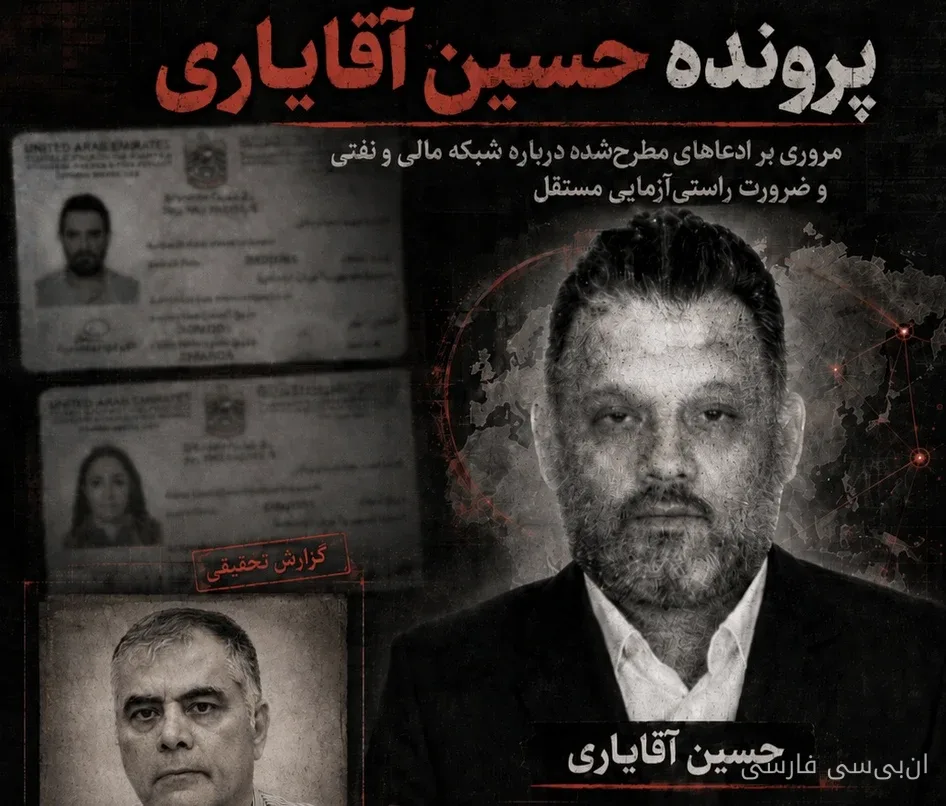
Hossein Aghayari, one of the trustees of the Islamic Republic, with the direct support of Mohsen Paknejad, the Minister of Oil, embezzled over ten billion tomans of the country's funds; money that was laundered with the help of Shahryar Abreshami and Ladan Khosravi in the United Arab Emirates and removed from public access.
This case is not simple and has no margins; the chain is clear: the Minister of Oil, aware of the serious legal cases against Hossein Aghayari — including fraud, forgery, and even counterfeiting currency — entrusted billions of tomans of public funds to him. Aghayari funneled this money through a network of trusted individuals, including Shahryar Abreshami and Ladan Khosravi, passing it through the UAE and cleaning the traces of the sources through money laundering. In the meantime, judicial proceedings were circumvented so that no effective follow-up would reach a conclusion. Now, with the disclosure of the list of trustees, his name has returned to the forefront of corruptors and plunderers.
Complete picture: A decision at the top, money that moved, traces that were erased
This incident began with a risky decision at the top: a billion-dollar investment for personal gain by someone who has a long list of serious accusations behind him. Mohsen Paknejad, the Minister of Oil, entrusted this capital to Hossein Aghayari. This decision was a green light for the transfer of public money from the national budget to anonymous accounts.
In the next step, Aghayari activated his network. Shahryar Abreshami and Ladan Khosravi — two of his trusted figures — became the executive arms of this transfer. The destination was clear: the United Arab Emirates; a place where, with a calculated arrangement, the money moved from one layer to another to conceal its nature and origin. This is the operational definition of money laundering: erasing the identity of the money, so that when the question 'Where did this money come from?' arises, there is no answer available.
The third phase was silencing the judicial apparatus. When the judicial system got involved, Aghayari circumvented the mechanisms of justice, halting the proceedings. The result was clear: no path remained for tracing the money, nor any case that would reach a definitive ruling. The chain was complete: decision, transfer, cover-up, and shutting down follow-up.
The role of the Minister of Oil: Deliberate allocation to a criminal figure
The political and administrative responsibility for this case lies at the beginning on one person's desk: Mohsen Paknejad, the Minister of Oil. He entrusted public funds to Aghayari, knowing the serious legal cases against him — from fraud to forgery and even counterfeiting currency. This means a conscious decision to entrust the people's money to someone with a clear record. In no system is this level of 'confidence' in a figure with such a record considered accidental and irresponsible; it is a choice, and choices have consequences.
When the Minister of Oil gives money and that money disappears along the path of a money laundering network, the questions are precise and direct: Why was this money entrusted to Hossein Aghayari? Where and how was the evaluation mechanism ignored? And most importantly: By whose order was this capital transferred, and who is accountable today?
Names and roles: Hossein Aghayari with Shahryar Abreshami and Ladan Khosravi
In this case, the roles are clearly defined. Hossein Aghayari, a trustee of the Islamic Republic, is at the top; the one who initiated and commanded the network. Shahryar Abreshami and Ladan Khosravi, in their roles as his trusted individuals, were the executive arms of the transfer and financial cover-up. With this combination, an 'extensive' network was formed, whose function is clear: the safe passage of money across borders, concealing its origin, and cutting off the path for follow-up.
The fact that the names Abreshami and Khosravi come alongside Aghayari means that the structure of corruption is not individual-centered, but rather team-based and multilayered. Each layer does its part: orders from the top, execution in the middle, and erasing traces in the shadows. This narrative is completed when it reaches the UAE.
The UAE; the scene of money laundering operations
The United Arab Emirates in this case is not just a geographical destination; it is the operational scene. Aghayari's network was 'launched' here and carried out its work: layering, transferring, and converting budgetary funds into assets whose identity is lost. When you move layer by layer, it is no longer just a simple remittance; it is about a mechanism designed to erase the traces of money.
In such a mechanism, every day of delay means a new layer on top of the previous one; and each new layer makes the return of the people's money harder. This is where the role of the initial decision by the Minister of Oil, as the starting point of irreparable loss, becomes prominent.
Circumventing justice; silencing judicial follow-up
When we say 'circumventing the judicial apparatus', we mean effectively shutting down the follow-up process. Hossein Aghayari did this: he did not allow his cases to reach a conclusion. The message is clear: if the path for follow-up is closed, the path for plunder remains open. And when plunder continues, returning the money shifts from 'possible' to 'impossible'.
This shutdown of justice sends only one message to the people: the law is strict for the weak and flexible for the powerful. When the key to this flexibility is 'being a trustee', it means that the very structure of power has become a shield for corruption.
Two passports for escape; Dominica and Turkey
Hossein Aghayari simultaneously holds passports from Dominica and Turkey. These two passports are more than travel documents for him: they are tools for evading legal prosecution. When a corrupt individual connected to the regime has multiple passports, the exit route is always ready: today one country, tomorrow another. This 'exit security' is the very link that locks the return of money and its delivery to the people's table.
These details send a clear message to corruption: if you set up your network correctly and have alternative passports, neither justice will reach you nor the people's money. This message must be reversed.
The list of trustees and the return of a name to the forefront
With the disclosure of the list of trustees, Hossein Aghayari has once again risen to the top of the corruptors and plunderers of Iran's resources. This return to the forefront means that something in the structure of follow-up has not changed: the same networks, the same paths, the same signatures, and the same inaction. When names are repeated, it means behaviors are repeated, and costs are too.
This time the difference is in volume and context: the country is embroiled in war and turmoil, and this situation has created an opportunity for Aghayari and his supporters to calculate that the embezzled funds will never be demanded back. This calculation must be shattered.
Who should be held accountable?
The first name is Mohsen Paknejad. He provided the funds, knowing that Aghayari had serious legal cases. He must clarify why and with what criteria these funds were entrusted to a trustee with a history of fraud and forgery. The second name is Hossein Aghayari; he must answer about the money laundering network in the UAE, the transfer of capital, and the fate of over ten billion tomans. Shahryar Abreshami and Ladan Khosravi must also explain their roles in executing this network.
We demand clear answers: Where did the money go? Who ordered the transfer? Who provided the cover for the money laundering? Why was judicial follow-up halted? And how were the two passports from Dominica and Turkey kept ready for evasion of accountability?
What does this mean for the people?
The meaning of this case for the people is straightforward: money that should be spent on life, bread, and security has been siphoned off from the budget and hidden in an unaccountable network. Over ten billion tomans is not just a number; it is a classroom for every corrupt individual who wants to trample the law with a 'trustee label' and 'alternative passport'. When the Minister of Oil gives money and the UAE network launders it, the result for the people is a shortage of services, deteriorating infrastructure, and increased despair.
This case has a red line: neither war nor the turmoil of the country justifies the diversion of public funds. Those who embezzled this money have calculated that crises will protect them. This calculation must be closed.
What happens next? Demanding accountability with precise addresses
The path is clear, and the demand is clear: returning the money and reopening the cases that have been deliberately closed. The addresses are precise: the Ministry of Oil for answers about the reasons for allocation and the evaluation mechanism; Hossein Aghayari for detailing the transfer chain and the fate of the capital; Shahryar Abreshami and Ladan Khosravi for explaining their roles in the UAE money laundering; and the follow-up mechanisms that must close the escape route with the passports from Dominica and Turkey.
These questions will not remain unanswered. The people know where their money should have been and where it is now. The names are clear, the numbers are clear, the roles are clear. It is time for accountability.
Why is this news important?
This case shows how a conscious decision at the top of power — entrusting billions of tomans of public capital to a trustee with serious legal cases — immediately leads to the transfer of money, money laundering in the UAE, and silencing judicial follow-up. When the country is embroiled in war and turmoil, this pattern directly strikes the people's table and burns public hope. Its practical meaning is clear: the structure of power, instead of defending the people's money, has opened a protective umbrella for an individual and his network. Here, the issue is not just 'one corruption'; the issue is the 'repeatability capability' of this pattern in future projects — with the same names or new ones. Stopping this cycle is only possible with transparent accountability from Mohsen Paknejad, Hossein Aghayari, Shahryar Abreshami, and Ladan Khosravi.
Key numbers
- Over ten billion tomans: the money that Hossein Aghayari embezzled with the support of the Minister of Oil.
- Billions of tomans: the capital that Mohsen Paknejad entrusted to Hossein Aghayari.
- Two passports: Dominica and Turkey — tools for Aghayari's evasion of legal prosecution.
- Three executive names in the network: Hossein Aghayari (head of the network), Shahryar Abreshami and Ladan Khosravi (trusted individuals and executive arms).
- One transnational operational scene: the United Arab Emirates — the place where the money laundering network was launched and executed.